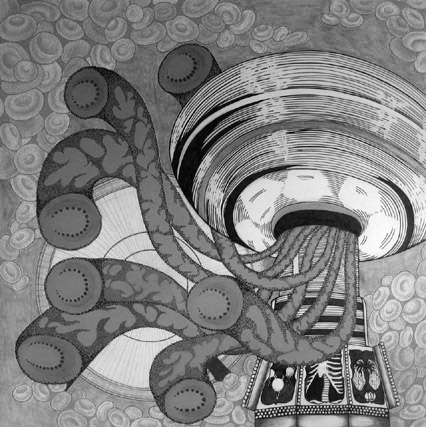
Prose
Please note that Read This is not currently accepting submissions, but you can visit our sister-site, OneNightStanzas.com
for literary advice, resources and other opportunities to be published!
The Family Tree by David Dykes
Then my mother wrote our family tree all around the room. I was down nearest the skirting-board, and the rest went up and up, out and out, back and back, until the room was surrounded by ink, like cracks in the plaster, and I could see everything: all the drops of blood that were in me, floating in black veins on the wall. There was a branch of crooks on the east side and a succession of politicians on the west side, and my father said "What's the difference?", so this might've been during the miner's strikes, although it must've been after the miscarriage—I remember my mum crying a lot, she cried a lot then, in that empty room. She blocked us all out and pulled out her hair pluck by pluck, that was an obsession, she held a pillow to her stomach, that was an obsession, she'd go through my baby book, that was an obsession too.
She cried in bed as well, face down, it'd be wet with tears and she could see her face imprinted on the sheets, like the Turin Shroud, maybe. She'd wake up with her pillow soaking, and hang it out from the bedroom window to dry, when the wind was strong it tried to escape the house, and on days when the wind was low it hung like a thief. That could've been later though. And my dad would do the same with his pillow, he didn't cry, but he did the same, to say, It's okay to cry. I miss him too, it would've been a he, and he put it out from the bathroom opposite, so I would stand outside and watch the two white sheets fluttering from either side in the wind: they were like angel's wings, and I remember wishing that my house would fly away, up and up, but the wings weren't big enough, I guess.
It took months to complete, the family tree, we went through so many pens, my mum would be watching TV and eating her dinner then suddenly she'd bolt up and rush off. When she came down two hours later I'd have gained another set of fourth cousins or ancestors in the French Revolution; and the dinner would be cold, gravy congealing over mashed potatoes. She took me up when it was complete, and sat me down in the room, this grand opening, I didn't understand; I don't know how she got everyone, because I could never remember any of them, even after I spent hours in that room.
She'd be on the phone, I guess, she was on the phone a lot, and the bill would come back on five solid sheets but my dad never said anything, because how could he? The tree would get written down on sheets of paper, then again on the walls, and she'd chuck away the pieces of paper, so I'd find Arthur Copperfield, who was born in 1731, in the trash between leftover chunks of meat, Éléonore Loubet drowning in discarded soup, Christopher Threw between shredded up bills, Roy Copperfield under potato peels, and anyway, my mum sat me down in the room:
I was surrounded by my family, the names wrapped around me, circling, and my mum began to tell me everything about them, what everyone was like, and I could see where I came from—my blonde hair stepped down across a series of uncles and aunts, my emaciated form ran down my father's emasculated ascendants, the flick on the end of my nose leapt across cousins of varying relations. I slept in the room one night and felt their names come off the walls: they scuttled over the floor with tails tapping against the woodwork, crawled all over me like spiders, and the words pierced my skin, so my family flowed around inside. I told my mother about this, how I felt I knew my place in the family, she just laughed distantly.
It wasn't enough for my mum, feeling them wasn't enough, I had to know them. She'd keep me up there for hours on ends, going over the names, tracing the lineages, I saw how I came to live: the descendent of a Dutch peasant who got the mayor's daughter pregnant, my family were never lucky with pregnancies, he left quickly after that, and his name got eaten up by my mother's great-grandfather, but I wondered how much of him remained. My mum told me, "I named you after a Bible king," and I wondered, too, how long it'd be before that name was buried with hers, I thought about this constantly as she went over all the branches, listed all these sections of people, a mosaic of a broken family cast around the walls of that empty room.
My dad didn't really like it, I could tell, but he still didn't say anything, he just quoted Oscar Wilde a lot. "A man can be happy with any woman so long as he does not love her", "Selfishness is not living as one wishes to live, it is asking others to live as one wishes to live," he would say, thanks dad, thanks. He read a lot, my dad, at one time he wanted to put the books in that empty room, but he couldn't, he couldn't fit them in along with my mum, so they were stacked around the house. I picked up an anthology of John Donne poems and saw his handwriting beside the verses, his scrawl slitting in between lines as he left his thoughts on the page, and found out why my father thought a man could be an island.
My mum didn't read, only medical textbooks, she got a lot of them, to find out what disease were spread genetically, it was an obsession, she tracked the defects across bloodlines, into coroner's reports, to herself. And she went over the family tree again, that was an obsession, reading the relationships over and over, and she kept trying to get me to learn it all, that was an obsession too.
I wish I could say I learnt all my family, that one day something came to me and it all made sense, that I could tell you some story about something I saw: a tree in the forest, its branches were tangled and splintered like my mother's hair and it was full of twenty types of birds. Tattered crows were being mocked by their jay cousins, magpies were sitting in their mock dinner suits, the swallows swooped in and out of the boughs, and I saw how everything was related, how my family was no different.
Or: it rained one afternoon and I went down to the back of my garden, we had a compost heap there, and I lifted up a rock to see all the bugs underneath, I saw the ants and the centipedes and the earwigs and that con-artist woodlouse, they swarmed over each other; but I didn't see any of this and I can't tell stories, I'm fed up of hiding my intentions behind metaphors.
I wish I could tell you it wasn't my fault, my mum lost her patience with me too quickly, but she didn't, she kept trying to teach me for months and months, "Come on," she'd plead, "we've been over this," and I guess the fact is, at the time, I didn't care enough, she shouted at me and chucked me out of the room one time finally, and shut herself in. She didn't come out for days, just pounded against the walls and ripped her hair out. Once my dad had finally coaxed her out it was off-bounds; for everyone except her and books of hereditary diseases. I ran past it at night and during the day you'd swear it pushed heat away, that's how cold it felt to brush past.
No-one went in, not me or my dad, not my grandparents when they came over to visit, it stayed empty, sometimes she'd lock herself in, threw herself against the door to barricade the entrance and blocked us all out, everything out, all I could hear from my room next door were the heaving sobs and punches thrown at the wall, my dad would get so anxious that he'd stay the opposite side of that door for days as well; at first he used a cup and glass to track her movements but eventually they had a series of knocks and taps. He'd knock once, rapping on the door, Are you okay?, and my mum would knock back twice, I'm okay, I'm okay, or knock back once, No, but don't stop knocking, please, and I'd hear this rain-beat throughout the night, a simple and required Morse code.
After the funeral, my dad still couldn't bear to go in and I was the only one who did, I don't know why, my grandparents didn't want to either: it was dusty, I remembered it in black-and-white like a zebra's camouflage, but it was just grey and filthy. I guess the idea that she'd clean the room hung around in the air and we didn't want to throw it away, at first I didn't notice anything different except the frayed rope ends and the buckled doorframe where my dad had broken in, finally—he blamed himself, of course—but then if I was the type to have noticed it straight away then maybe I wouldn't have to tell you this story.
Taking a closer look at the family tree I saw that my mum had added notes, they reminded me of how my father had annotated his books, how I in turn annotated my books—leaving fragments of my thoughts on the pages as the broken syllables and half-rhymes were left on my brain—but my mum had left medical notes by them all, detailing the bloodline's corruption, our faults and guilts and crimes, that was her obsession, she must've have spent hours doing them all, that was an obsession, it was all laid out so precisely and neatly, that was an obsession too.
The family of crooks all had syphilis, and the politicians too, my dad would've liked that but I never told him, some Swedish royalty we barely laid claim to had a incestuous blood disease and around those Dutch peasants and my mother's family the notes became more frantic and desperate, her great uncle had asthma, a cloud of cancer hung round my uncle's head, killing off his three wives, he had dyslexia like his father, diabetes hopped around in our veins, skipping generations; in a carefully controlled thick pen line the word SCHIZOPHRENIA was marked out near her cousin's name but it stood alone, isolated, and the word DEPRESSION lead to her from my brother's unborn name, sketched on the skirting-board.
Vinnie tiptoed as quietly as he could into the bedroom. He stood at the foot of the bed for a minute watching Lee sleep. His long muscular frame was wrapped in the duvet, one foot hanging out as always, his lush dark hair flopping out over the pillowcase. Vinnie thought to himself, how did an ugly old bear like me end up with such a beautiful man?
He moved to open the curtains but stopped, hearing Lee whisper from under the duvet.
'Not yet...'
'Come on, it's practically dark again.' Vinnie said.
'Please, just a few more minutes?' Lee sat up squinting but his voice was like chocolate and Vinnie melted.
'Do you want some breakfast?'
'Please.'
In the kitchen Vinnie busied himself with the frying pan. Black pudding sizzled and Vinnie added a couple of sausages for himself. He'd already filled the dishwasher and put a load of laundry on and what with that, the sound of breakfast frying and the kettle boiling, the kitchen felt like the satisfying hub of the home. Just like a normal family thought Vinnie. I'm a proper domestic goddess. Just a bit hairier.
Lee had finally woken up. He came into the kitchen and sat at the table. He was wearing his long housecoat, which Vinnie thought made him look like some sort of youthful aristocrat, and sunglasses, which kind of spoiled the effect.
'Here', said Vinnie, 'Best I could do until “you know where” opens.'
Lee frowned at him from under his shades.
'You're just too good to me aren't you?'
Vinnie bristled at the sarcasm and started setting breakfast on the table. Lee poured himself some orange juice.
'So have you seen the newspaper?'
Vinnie looked. The headlines read: TWO LOST IN STORMS; GAY CELEBS TO DIVORCE, and an advert for cheap flights.
'So?'
Lee stood up and hurled his plate onto the wall. Black pudding and Royal Doulton crashed everywhere.
'What..?'
Lee's fist hit the table. 'You lying little...'
'I...'
Lee lifted the table and threw the whole thing across the room. Vinnie cowered in the corner. Broken glass, crockery and food covered the lino.
'You've been at it again haven't you?' Lee picked Vinnie up and pinned him against the wall by the throat. His mouth smelled strangely seductive, like fresh steak and chianti. He was so close to Vinnie's face he could have been about to kiss him. . 'You promised all this was over.'
Vinnie spluttered, 'Put me down, you're hurting me.' His feet were dangling above the floor.
There was a moment where all was still, only the swishing of the washing machine and the dishwasher under the sink prevented total silence.
Lee flung him across the room with the same ease as he'd thrown the breakfast dish.
'Where were you last night?'
'You know very well where I was, where do I always go?' Vinnie was slumped now beside the dishwasher.
'I know where you were supposed to be. Jesus, Vinnie. I thought we'd agreed on this?'
'I wasn't...I promise...I...don't you trust me?'
'No.' Lee shouted, kicking over the chair. It narrowly missed hitting Vinnie's leg. 'You always take your bag with you when you go there. Do you think I'm stupid or something? I was still awake this morning. I heard you in the shower.' A look of sheer despair came over his face and with this he stormed out, slamming the door behind him.
Of course they knew when they first got together it was never going to be easy. I mean...who's ever heard of a successful relationship between a werewolf and a vampire? They'd met here in Saltcoats just over a year ago. Vinnie would say it was Lee who seduced him. Vampires have that weird magnetism after all. But Lee maintains that it was Vinnie's heavy eyebrows and muscular forearms that did it. He had that Colin Farrell thing going on. And he was funny with it. When they met they'd argued over whether Kerry Katona's drunken TV interview was fake or not. Lee thought it was for sure, but Vinnie was convinced the poor girl was the victim of the celebrity machine.
Vinnie had got down on one knee with his hands clasped together under his chin. Gazing up at Lee he'd wailed.
'Did Diana die on a cross for us for nothing?'
By which point Lee was laughing so hard he thought he was going to beat immortality.
Of course, that fact that Vinnie worked for the Blood Transfusion Service didn't hinder matters either.
It hadn't been long until Lee decided Vinnie was “the one”. Once he'd confessed he was a vampire (and what a conversation that was) Vinnie agreed that he too wanted them to be together forever. Lee agreed to give Vinnie the “special bite”.
They'd decided to do it on the beach at midnight. Both of them got dressed up for the event. Lee wore a long dark frockcoat, tight black jeans and a pair of vintage boots. Vinnie, in honour of his Scottish grandmother, hired a kilt to wear. The beach was deserted. Waves roared in the background, filling the night air with the scent of the sea. The moon was oval but bright. It's light illuminating the scene in shades of silver and indigo. Only the distant sound of late night revellers suggested the era this sacred act was taking place in.
Lee took Vinnie in his arms and kissed him.
'Ready?' he said. They were both shivering though it wasn't particularly cold at this time of year.
'As I'll ever be.' Vinnie paused. 'Will it hurt?'
'It should feel warm and kind of arousing.'
'Okay. Arousing's good.' He smiled, tilted his head and exposed his neck.
Lee drew back a moment. He opened his mouth and allowed his fangs to fully extend. Then he sunk them down into the warm flesh of Vinnie's throat.
A moment or two passed. To any onlookers it would seem merely like two lovers in an embrace.
Lee lifted up his head, blood dribbled slightly down his chin.
Vinnie waited. Nothing seemed to be happening. He wriggled his arms and legs a bit. Shook out his feet.
'Is that it?' he said.
'What do you mean, “Is that it”?'
'I don't feel anything.'
'Nothing at all?'
'Nothing.'
'Are you sure it's not working?' Lee said.
'I don't feel anything?'
'Not like a tingling sensation down your back and a weird buzzing in your head? Like you've taken really strong E?'
'Nope?'
'I can't work it out.' said Lee. His fangs had receded again and he screwed up his face in deep thought. 'Obviously it's been about a hundred years since I've done it but I'm sure I did it right.'
'Maybe it's because I'm a werewolf.'
'What?' Lee took a step back and nearly fell over in the sand.
'Didn't I mention that? Sorry.' Vinnie shrugged and gave Lee his best Colin Farrell grin. 'Thought I had already. It's part of the “condition” it um...kinds of messes with your short term memory.'
So they'd made an agreement that every full moon, Vinnie would take himself out to a nearby island. He'd bought a little boat especially. The island was uninhabited, apart from the gulls and other sea birds. These provided enough meat and sport to keep the beast happy. But then people had begun to go missing.
It was three in the morning when Lee came back after their fight. Vinnie was in the living room curled up on the settee. His eyes were red-rimmed and he was surrounded by a sympathetic army of scrunched up tissues. Lee lingered at the door.
'It's so hard.' Vinnie sniffed. 'I really have been trying you know? But any time it gets stormy I can't manage the boat. I've been dumping it and then walking further down the coast instead. I did try to find somewhere with less people around. You know how much I hate myself after I feed. But the scent of them. That human smell. It just drives me crazy, you know?'
'I know babe.' Lee sat down and cuddled Vinnie until his head was on his lap. 'We'll be okay.' he said, stroking Lee's hair. 'I've been thinking. There's a house for sale. Down near the beach front. It's got a wine cellar. I could use it during the daytime and when it's a full moon we could get some extra strong locks. What do you think? It's about time we stopped renting anyway, now the house prices are finally starting to fall.'
'I think it's a good job you're so much older and wiser than me.' said Vinnie.
'Hey. Less of the old yeah?'
All Lee had to figure out now was how to broach the subject of the young lady he'd picked up on his way back from town last night. And whether Vinnie would forgive him for giving her the “special bite”.