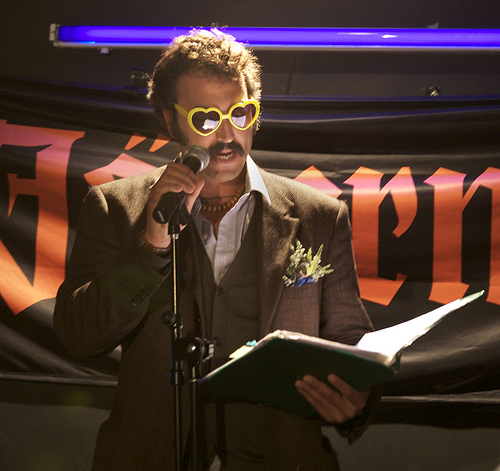
 Apologies for not getting this posted before the end of the weekend. Here, Josh speaks a bit about his writing — there’s also a final poem for you to enjoy. See the previous poems here and here!
I’ve been writing on and off since I was a kid. I used to write ten page novels based on Die Hard and Terminator 2. They had token sex scenes as imagined by a seven-year-old. Rimbaud would wince. I started writing ‘properly’, though, around the age of eighteen, after listening to too much Bob Dylan, Leonard Cohen and Bright Eyes. I would say my ‘proper’ writing stopped being awful and obscure a couple of years ago, around the time I started submitting to journals.
Like many young poets yet to learn their poetry history, I began writing a lot of absurdist, ironic stuff and thinking I was the shit – until I read Luke Kennard’s The Harbour Beyond the Movie and learned what poststructuralism was. I think it’s probably the best collection this current wave of young poets has produced. Unlike a lot of writers doing similar things, it takes the American poetry it is influenced by and does something original and exciting with it; it doesn’t simply ‘borrow heavily’ from its influences and give them a British accent. The reason I mention Kennard’s collection is that reading it brought about one of the most pivotal stages in the development of my writing so far – he was doing, had done, everything I thought I wanted to do with poetry, but better.
I’m interested in poetry that has a philosophical drive – not achingly overwritten drivel dressed up in line breaks and terminology, but a poetry that engages with ontological concerns as much as with linguistic innovation, as exemplified by amazing writers like Jorie Graham and Tim Lilburn, and, more recently, by the intimidatingly good Ahren Warner. In Thought Disorder, I’ve tried to explore ideas of perception, self and the other: what it is to be a subjective being, attempting to capture in writing the presence of things that are a priori absent, while trying to navigate some of the self-defeating pitfalls an awareness of postmodernism and poststructuralism can instil. It’s too easy to point out, in verse replete with windswept lyricism, that to express is to fail to express; more than that, I don’t think it’s even the case. The poets who have provided me with blurbs have probably elucidated the work far better than I could. Nonetheless, I’d describe it as a collection that knows its inevitable inadequacies and failures but, instead of isolating them and making them the object of the image, incorporates them, utilises them, sweeps up the debris of language and moulds it together into something that is (hopefully) expressing something worth hearing, without ever taking itself too seriously; a poetry that strives regardless to reach outside of itself and move forward, to enunciate clearly, to speak with assurance and not relish the incoherence of a mumble; a poetry that struggles to connect despite not being certain it can, that only turns its gaze on itself in order to turn away from itself.
What else? Composition and editing. I was very lucky to have such a good editor. The Thought Disorder MS was provisionally accepted providing I was willing to work with Alec (Newman, boss of Knives Forks and Spoons) on editing. Blindly excited, my answer was an immediate yes. Then he told me to take ‘Exposure’, the opening poem in the collection and, at the time, the one I thought was my best, and massacre it. I balked, but did as I was told, albeit tentatively. Until about five minutes after I’d started rewriting, when I realised that what he wanted from the poems, what he saw in them, was exactly what they needed to be, exactly what I wanted them to be without quite knowing it. So I’m very very grateful to him for taking the time to help me make the collection what it is. Since finishing it I’ve been on a summer-long writing binge, and have plenty of ideas for the next one. So it’s strange to go back to these poems, to have to get my head around them again. But I guess that’s a good thing – it stretches out the time it takes to get bored of your previous work when you can see it as other, as written by someone else, a past self.
I’m not really sure what to expect from it being published. It’s a fairly small-scale affair, so its success depends a lot on how willing I am to promote it – both an exciting and terrifying prospect. I guess, like every writer, I’d just like it to mean something to a reader. That and make some beer money. Or, even better, some rum money.
One Version of Autumn
It’s drunk inside and we are talking plans
because plans are what the press of wet dark glass instil
in rooms of jumpers and smoke and the thigh-touch
of warmth when the door is closed and light switched.
Plans: joining palms churchily and at least pretending
the heat of skin on skin is that of another, damp
empathy, shared teeth of a zipper closing its mouth,
shifting leaves from abstract paths and scrubbing shoes,
glint in the corner of the eyes at the sight
of white encasing feet ready to go and imprint.
You take a season like it’s a text in a mediocre class
and tear it apart until the word, let alone the concept, means
nothing, and there are empty cans
on the table that is enforcing the living room light
just the same as it would on any other night, and you
forget it even exists in the tonsil-fuelled room
and the whole time we are talking I can see
the headlights of a car through a gap in the curtain,
flecked with rain, rumbling like it’s building something
I wouldn’t understand until I saw it complete, finished,
and we have agreed that something is going to happen
at some point, on some day,
and we shake hands or hug at the end
and I construct my shape in the covers
heavy with dark and drink and sleep
and little breaths of cold and changing weather
creep in through inevitable gaps.
Praise for Thought Disorder:
“Thought Disorder is a fine first collection from Joshua Jones. These are terse poems that take the everyday and reimagine it in new and fantastic ways; each poem vibrates on the page, “rumbling like it’s building something,” shifting the ordinary onto a whole new plane. From phenomenology to smoke breaks, the girls downstairs to the turn of the season, this collection is unafraid to look at day-to-day life in all its manic, exuberant truth. “It doesn’t matter if it’s been done before”; these keen poems, with their dry wit and clear eye, are doing it in an entirely new way.” - Jenna Butler