Posts Tagged ‘gifted’

Things I Love Thursday #72

Thursday, December 13th, 2012

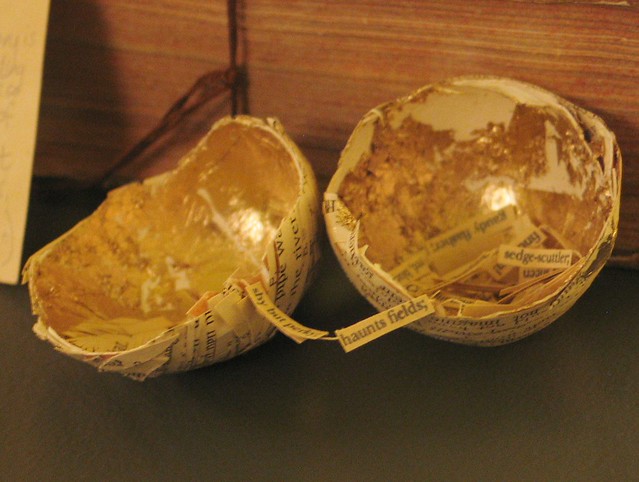
The amazing GiftED book sculptures at the Scottish Poetry Library.

I’m guessing that, since you’re reading this blog, you like books really quite a lot. Therefore, you’ve probably heard about GiftED, the series of sculptures made out of old books and gifted to various literary landmarks around Edinburgh. But just in case you haven’t, here’s the lowdown: over the past eighteen months, these beautiful, intricate book-based paper sculptures have been popping up in places like the Central Library, Filmhouse Cinema and the SPL itself. Nothing is known about the uber-talented creator of these objects, except that she’s a lady. Oh, and she’s on a valiant one-woman crusade to save libraries and keep people reading. In other words: this person is my heroine.

GiftED has been on tour around Scotland over the past few months, much to the delight of every bookish Scottish person ever. It’s just ended its run with a few days on show at the Scottish Poetry Library, and I was lucky enough to be able to go along twice to see these ten wonderful pieces on show all in the same space. Here are some photos of just a few:

After two visits and I-don’t-know-how-many circuits of the exhibition, I finally, painfully, picked a favourite — and it’s the T Rex. As with all the sculptures, every time I looked at him I saw something else: the words interlaced between his jaws, the tiny men in the page-forest trying to take him down, and — my favourite part — his wee tail sticking out of the back of the book! Magic.
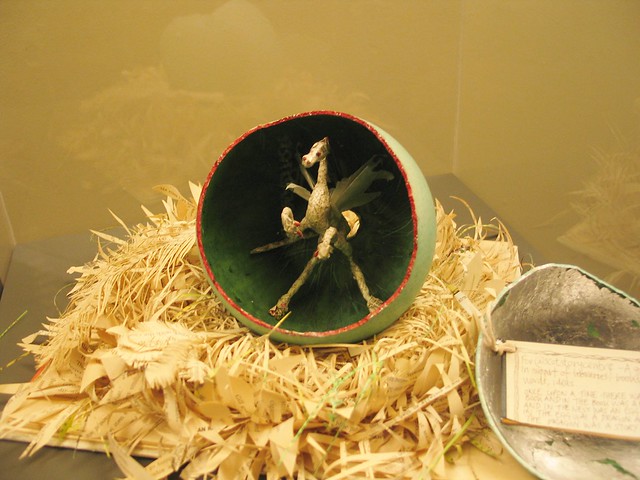
Dragonbaby 2

I also loved the dragon-baby. I thought it was such a nice physical metaphor for a book being born! He’s super cute, too. On my first visit to GiftED I was accompanied by the ladies from the women’s community support group I’ve been working with, and they were utterly enchanted by the whole thing. A few of us spent a while speculating over whether the dragon is nestled inside a real egg or not — is it an ostrich egg, maybe? It looks so real, we just couldn’t be sure.
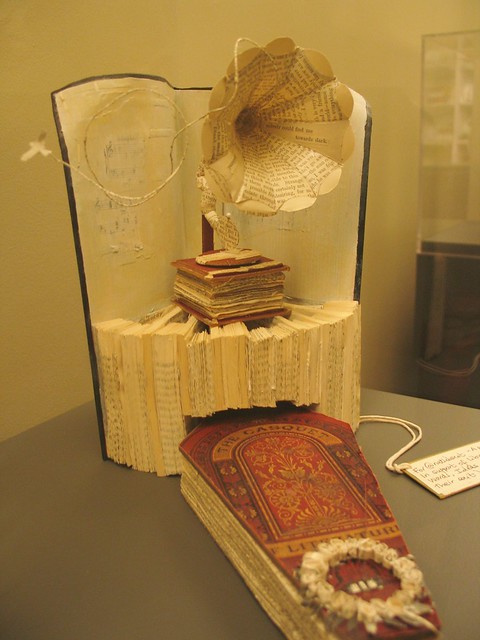
Casquet

I love the words that are carefully highlighted inside the gramophone… “towards dark.” This sculptor definitely has a penchant for the eerie and unheimlich!
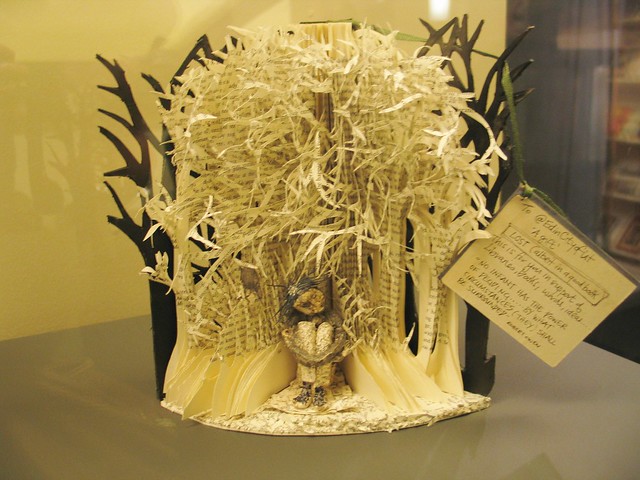
Lost in a good book

This was the one my group picked as their definite favourite. Over the past few weeks, we’ve been discussing poetry and the ways in which it can be used to help us understand the world, work through difficult times, celebrate happy times, etc. Many of the ladies in the group had never read a poem before in their lives, and therefore were understandably nervous at the start. But they saw this sculpture and loved it. One of them said, “that’s how I feel about books now — like you can be sheltered by them.” Result!
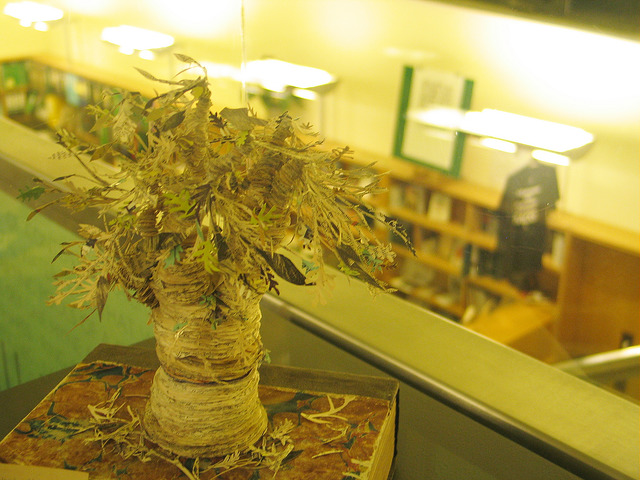
Poetree

Poetree 2

This — the Poetree — was the first sculpture, the one that started all the (totally deserved) hype. The exhibition (and its accompanying promotional book) contained an illustrated guide to making your own poetree! My favourite instruction: “inconsistencies add charm.” A good motto for life, methinks.

“Nothing beats a nice cup of tea (or coffee) and a really great book.” She speaks the truth! If you want to see the other sculptures (and er, much better photos of the ones featured here!) you can head over to the photostream of the wonderful Chris Scott, who, quite rightly, has become their de facto official photographer!

Having an ethical, hopefully-Amazon-free Christmas

I don’t want to sound too judge-y here, but you guys… is it me, or has Christmas become a time for assholeish behaviour? This assholeishness is weird, since Christmas is supposed to be all about being selfless and nice! It seems that, at Christmastime, some people become weird Mr-Hyde-type versions of themselves as far as all things greed and consumption are concerned. Christmas is the time of year when we do things like stuff a bird into a slightly bigger bird and then stuff both those birds into a slightly-bigger-again bird, roast, and then scoff so much of the resulting Frankenbird that for the rest of the day we can’t do anything more taxing than occasionally nibble the edge of an enormous Toblerone. We spend a bazillion pounds each on a bazillion presents, usually from massive high-street and internet conglomorates who dazzle us with their sparkly TV ads (if I see that goddamn awful Brad Pitt Chanel No. 5 ad again I may smash Lovely Boyfriend’s beloved UberTV to bits). We buy presents for people we don’t even like because we feel like we have to. We send 1.5 billion Christmas cards TO LANDFILL for chrissakes. Sorry to sound like the world’s biggest Scrooge, but it’s effed up, y’all. It’s time to OCCUPY CHRISTMAS!

OK, maybe that’s a bit radical for the moment. But still — this year I have been trying to stick to the following Christmas rules:

- Buy second hand wherever possible
- Buy local wherever possible
- If you can’t buy local or second hand, at least buy from an independent business or charity org
- No sweatshop labour
- No animal cruelty
- No waste
- No Amazon purchases

I’m now pretty much finished with my Christmas shopping, and I know I’ve broken my rules a bit already. For example: I bought a box of chocolates for some of my workmates that I know has dairy in it, so animal cruelty (*cries*). I can’t go into more specifics right now without giving away what other presents I’ve bought, but I might do a re-cap post-Christmas and evaluate how I did! In the meantime, I’m doing crafty, waste-free stuff like wrapping my gifts in old brown paper bags and pre-used wrapping paper (see photo above — I’ve been saving all year from birthdays etc!) and making present tags out of last year’s Christmas cards (see photo below). I’m feeling super righteous, very crafty, and really unusually rich for this time of year as a result!

The new issue of The Edinburgh Review: #136, aka No Shouting Out.

This isn’t just making the list because I have a review in it, but, well… I have a review in it! This is my fourth contribution to The Edinburgh Review in twelve issues, and I’m really happy that they keep accepting my work! I love the publication, especially since Alan Gillis took over the role of Editor-in-Chief — he’s doing fantastic work. Look how pretty this issue is!

My review is on Kerry Hardie’s most recent collection, The Oak & The Ash & The Wild Cherry Tree. Hardie is hands-down one of my all-time favourite poets ever ever ever, so needless to say, my review is pretty glowing. You should all seriously buy this book straight away, because it is brilliant. It’s about ageing and death and nature and birds and skies and trees and memory and it’s GREAT! Get it, get it one and all.

Want to read more? Well, you’ll have to buy The Edinburgh Review, then! Except the issue’s so new, it seems to be not-available-online-yet. It will be, though — keep an eye on the site. There are a million other (better!) reasons to buy a copy too, of course — Hannah McGill has a GREAT short story in here, and the fantabulous Jen Hadfield has written a highly right-on review of William Letford’s Bevel. Hey, why not go the whole hog and get a subscription?! So worth it, trust me, and they’d love and appreciate your support for sure! If you’re in Edinburgh, you can also keep an eye out for the issue in bookstores, including the wonderful Word Power.

What are YOU loving this week?

*

You can also visit Read This Press for more poetry (and typewriter paraphernalia!). Alternatively, check out Edinburgh Vintage, our sister site. If you want to get in touch you can follow OneNightStanzas on Twitter, or email claire[at]onenightstanzas.com. I reply as swiftly as I can!
Procrastination Station #117

Friday, December 7th, 2012

Procrastination Station’s been taking a break these past couple of weeks, so here’s a bumper edition of what I’ve been loving online lately!

Embarrassing admission: I never knew E Nesbit was a woman. I also love this poem of hers.

Speaking of poems by women, there’ve been some fantastic ones at the Poetry Foundation recently! Thanks Chris for alerting me to this one by Leigh Stein, and to Freesia for sending me in the direction of Peanut Butter by Eileen Myles. This one by Bernadette Mayer is pretty cool, too!

Are you a Flannery O’Connor fan? If you’re also patient enough to let this F O’C soundboard load, it will MAKE YOUR DAY.

The idea that there is only one right way of doing English – and everyone else is doing it wrong – is inherently flawed. And by “flawed” I mean illogical, elitist and even oppressive. Judgements about what counts as “right”, “good” and “correct” in writing and grammar always – ALWAYS – align with characteristics of the dialects spoken by privileged, mostly wealthy, mostly white people. We make these judgements based on learned biases, as well as a certain emotional attachment to our own way of doing things. But when people study dialects in an objective, scientific way (which is what cunning linguists actually do), they find that low-prestige dialects, such as African-American Vernacular English or Cockney English, have fully-formed grammar rules of their own that make just as much sense as any others. They are perfectly valid and functional forms of communication used by millions of people. The only difference is that they don’t have people running around telling everyone else to do it their way.

This piece on literary privilege is great (and I’m totally a still-recovering grammar Nazi).

This ‘how good is your pronounciation?’ test has been doing the rounds of the internetz forever, but the other day I tried actually reading the whole poem aloud. “Loth” caught me out!

One of my poems from The Mermaid and the Sailors was graciously published by Writers for Libraries. It’s a great project and you should definitely check it out.

The lovely Mandy is featuring my weird and wonderful sister and her wacky advent creations at her blog right now!

If you live in Scotland you should absolutely take this survey, and be part of the Equality Network’s consultation on how to make our fine country better for LGBT*QI folks.

Melissa McEwan is one of my all-time favourite bloggers, and this is a great interview with her.

Oh, I’m sorry, thin people, for exercising in your gleaming anti-fatness temple, but I’ll wear these baggy clothes and stay away from the popular machines so I don’t inconvenience the real exercisers.

Lindy West is awesome. I loved this article of hers on fat people going to the gym. And in related news, the equally awesome Lesley Kinzel writes about how truly terrible shapewear is.

I now want to write EVERYTHING in this font! (Thanks Mandy!)

20 Things Overachievers Like struck a bit too much of a chord with me… (except for the unpaid internship part, because I can’t afford that. Oh, and the working out.)

…and speaking of lists, The 21 Most Awkward Situations In History is really rather amusing.

Things I love: tea, typewriters, and cardigans.

Have you guys seen Barack Obama Being Adorable With Adorable Children? Prepare to smile.

& speaking of which… TERRAPIN RESCUE!

OK, I’ll be honest: I’ve watched this video about ten times. This woman FASCINATES me. Not just because she’s super super hot, has amazing tattoos and basically the cutest laugh-face ever, but also because of what she’s doing with her modelling and her philosophies thereof. I DEFY YOU NOT TO FALL IN LOVE WITH HER JUST A LITTLE BIT.

A little bit of idealism to brighten your day — and I love the narrator’s voice!

This week I went to see the GiftED sculptures on the last leg of their Scotland tour. Find out more in this lovely short film about ‘em!

Paper Sculptures GIFTED Tour 2012 from Blue Iris Films on Vimeo.

When the wonderful Watsky came to Edinburgh for the Watskyx2 gig I hosted, the Scottish Book Trust asked him to read a poem for them. It’s finally online!

I love the Big Bang Theory and want to be Amy Farrah-Fowler’s best friend. Therefore it stands to reason that I love this flashmob the cast and crew did recently!

& finally — have you watched Kilroy Loops yet? TRIPPY AND HILARIOUS.

Have a great weekend!

*

You can also visit Read This Press for poetry and typewriter paraphernalia! Alternatively, check out Edinburgh Vintage, our sister site. If you want to get in touch you can follow OneNightStanzas on Twitter, or email claire[at]onenightstanzas.com. I reply as swiftly as I can!

Things I’m Reading Thursday #28: the trouble with “Outliers”

Thursday, September 22nd, 2011

Malcolm Gladwell at UofT

Is this really my first TiRT since May? I really need to get my head back in the blogging game, guys. I also apologise for the fact that ONS seems to be slowly seizing up — some of you have brought to my attention the fact that the site is taking an age to load. I am unsure exactly why this is, but have some theories. The 750,000+ spam comments (yes, really) sitting in my moderation queue probably aren’t helping. I’m onto it. Apologies.

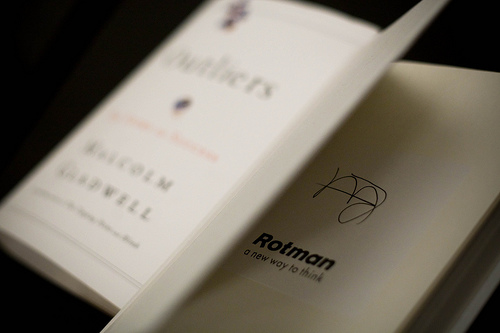
Anyway, I just finished reading Outliers: The Story of Success by Malcolm Gladwell. I’ve had so many breathless, near-orgasmic statements foisted on me about this man’s books that I’m genuinely shocked that I never got around to reading him before. I remember my mad flatmate reading The Tipping Point when it came out and practically going into apoplexy about it over breakfast one morning. Five years on and a couple of weeks ago she gave me a book token, and the words “dude, have you still not read any Malcolm Gladwell?”

So, I trotted off to Word Power Books and, as commanded, bought Outliers, the Malcolm Gladwell book whose blurb had most piqued my interest when I nosed through his various titles. And yes, it is a damn fine book. I got through it so fast and so hungrily that it was more like inhaling a book than reading it. He’s a great, great writer — probably (I feel unqualified to really comment, having only read one of his books) deserving of all the praise heaped at his feet — “global phenomenon” (The Observer), “the best kind of writer” (The Times), “the world’s most influential thinker” (GQ), and so on. And the book itself is full of fascinating stuff — I was shocked, enlightened and inspired. Usually, nothing puts me off more than a soc-sci book with a ton of tables inset to illustrate points. This book is the exception to that rule — the tables and diagrams were almost always the book’s biggest “no way?!” moments.

However, as well as greatly enjoying the book, and coming out of it feeling like I’d learned heaps, I also felt deeply troubled by it. In chapter after chapter, I couldn’t help but draw parallels between Gladwell’s examples of “lucky” (as opposed to “gifted”) or “disadvantaged” people and scenarios, and my own experiences both as a student and a teacher in the UK education system. Gladwell points out perceptively and highly persuasively the ways in which seemingly minor idiosyncracies of a country’s bureaucratic policy or national psyche can make huge differences to the ways in which different people within that country behave and progress. And although he drew largely on examples from Canada, North America and Asia in his exploration of these concepts, I feel like Outliers might have a lot to tell us about the way we talk to, think about and educate our kids here in Scotland.

I daresay you’re raising a skeptical eyebrow right now, but hopefully you’re still with me.

Gladwell talks about Canadian all-star hockey players (I’ll try and chop the entire chapter he devotes to a phenomenon called relative age advantage down as much as possible). Basically, if you want to be a famous hockey player in Canada, you have to start as a kid and work your way up through various club leagues, and your eligibility for these is based on your age. All the recognised clubs set their age eligibility cut-off date at January 1st. Gladwell argues, examining various jaw-droppingly convincing studies as he goes, that this gives a huge advantage to players born at the start of the year. After all, he says, if you’re born in early January, you have the advantage of eleven months’ emotional and physical growth over your team mate who was born in December. And when you’re a six-year-old, that means a hell of a lot. The stronger and more mature kids get picked for extra coaching, and progress through the ranks and leagues. The effect is cumulative, and the result is that the vast majority of star adult hockey players in Canada were born between early January and late March.

It’s not a great leap, then, to the Scottish education system, whose age eligibility cut-off is the end of February, as opposed to the beginning of August or September in England. I began my primary school education in England. I was born on March 10th, and was among the younger kids in my class group. My sister Helen, who was born in late January, was two years below me and smack-bang in the middle of her class group. We both performed at a level best described as “OK” academically, but I did not get on at all well socially. Helen was a fabulous mover-and-shaker, loved by all. I was — and to an extent, still am — chronically terrible at forming platonic relationships.
When I was eight, my family moved to Scotland. Because of the change in eligibility cut-off date, I went from being one of the youngest in my class group to the very oldest. My sister went from being right in the middle of her year, age-wise, to being the very youngest. The cut-off date also meant that we ended up only one academic year apart from one another — we went from Year 3 and Year 1 respectively to Primary 4 and Primary 3.
And something weird happened: I shot to the top of my class. Suddenly, I was outperforming everyone else in my year group. Helen, meanwhile, began to suffer academically. Concerns were raised by some teachers about her “bad” spelling and daydreamy manner in classes. Within one academic year we went from being pretty similar in our academic performances to being at opposite ends of the scale.

People have offered various explanations for this. I’m a classic first child, Helen is a classic second child, for example. I’m more like my maternal family, the Robinsons — self-confident and unapologetic (so, successful but not very likeable) — while Helen is more like our paternal family, the Askews — quieter and more introspective. It’s even been suggested that it’s down to me being a Piscean and Helen being a Capricorn-Aquarius cusp child. However, reading Outliers has made me think: wait a second. Is this actually all about totally arbitrary school year eligibility start dates?

If it is, the implications are serious. It’s not just a case of “hey, that’s weird, isn’t it?” Follow Helen and I through the rest of our compulsory education: after my rocky first few years I stormed through school. At Standard Grade I got seven Grade 1s and one Grade 2 (Maths, which I hated with a passion). At Higher I got five As and as a result, unconditional offers to study English Literature at five of my six chosen universities, Edinburgh, Glasgow, Newcastle, Manchester and Liverpool. (The one who turned me down was York, but that may have had something to do with the fact that the course I applied for, English and Writing for Media, took only 20 students per academic year). Helen got a mixed bag of 1, 2 and 3 results in her Standard Grades, and at Higher her results were ABCCC. She originally applied to study Drama after school, but after getting called for some auditions, decided she couldn’t hack the snotty theatrical types. She ended up getting into Carlisle Institute of the Arts (now part of the University of Cumbria) to do a Foundation Degree in Fine Art via clearing.

Follow us even further, to the present day. I have a MA, a MSc that I won a scholarship to study, and I am about to graduate with a PhD at the age of 26. I work as a lecturer for the largest Further Education college in Edinburgh, as well as tutoring at my alma mater. I’m also a published writer.
Helen has completed a BTEC in Art and Design, a year out working in a kilt store and a hard-won BA in Graphic Design. She currently works part time in Paperchase.

Why am I writing this? Do I hate my sister and want to humiliate her, and have a good brag about my own abilities? Absolutely not. I’m one of those sickening people who thinks of their sibling as their best friend — she is the person who means the most to me in the whole world. Nope, I’m writing this because, as a result of reading Outliers, I’ve begun to think that maybe I am not as “academically gifted” as all my school reports would have had my parents and I believe, and that maybe Helen is not the “supermassive failure” she is sometimes wont to apologise for (don’t worry, I always tell her to shut the hell up).

The whole point of Gladwell’s book is to point out that actually, there is no such thing as “gifted”. There is only lucky versus unlucky. He talks at length about the cumulative nature of advantages — that once a person gains an advantage over their peers, they are thrown into the path of further advantages, while those same advantages slip further and further our of reach for the folk who didn’t get that first, minor boost. Helen and I are a great example of that. I genuinely believe that I am no more “smart” or “intelligent” or “gifted” than she is. She knows a hell of a lot about stuff that I’m clueless about. She can hold her own in a fierce intellectual debate much better than I can (I have a tendency to get cross). She is still far and away better at forming platonic relationships and handling social situations than I am. If anything, she is far more confident — she’s also a realist, where I’m a dreamer and a procrastinator. Her vocabulary is every bit as varied as mine. Helen and I had an identical start in life, outside of education, and I’ve often wondered why our paths have been so very different. Now I’m left wondering if getting bumped to the top of my year age-wise gave me the academic boost I needed to get good grades in high school, which in turn opened up better opportunities for me in the worlds of employment and post-compulsory education. Helen, meanwhile, seemingly took a step backward with the change in cut-off date — suddenly her supposedly “bad” spelling was being compared to the performance of kids almost twelve months her senior. At the age of just six years old, Helen was being given messages of “you’re not good enough” by her teachers. I’m no child psychologist, but what kind of snowball effect could that potentially set in motion?

Malcolm Gladwell points out that if there were two cut-off dates for kid hockey players, one in January and one in June, Canada would have twice the number of all-star adult hockey players; that, or the birth months of those who made it to the big leagues would be much more diverse. “Hey, how weird,” we say, and close the book and think about other things. It’s just hockey, after all (OK sorry, I know that’s blasphemy to a Canadian). But what about our education system? The principle is the same, and if my experiences are anything to go by, the result is the same too. Therefore, the way our education system is organised is instrinsically unfair. Yes, in Scotland parents have the opportunity to defer younger kids from starting school for a year if they feel they’re not ready, and yes, there’s always the opportunity for your child to repeat or “stay back” a year if their young age is seen to be a problem. But how often is age identified as the cause of a child’s difficulties? How often do parents and teachers alike just assume that the kid in question is “just a classic second child”, or “just more like their dad”, or “just a typical Aquarius” (gah!), or hey, “maybe they’re just Not That Bright”? Furthermore, what parent wouldn’t hesitate before keeping their kid back a year? What might that do to the socialisation of a child — after all, some of the fiercest friendships you ever see are between individuals under the age of ten?

I shudder to think about how many kids are potentially losing out on academic (and other) opportunities because of something as arbitrary as their birth date. Particularly when I think that my sister might be carrying the legacy of this bureaucratic quirk in the system around with her for her entire adult life. That is damn scary.

(Photo by hyfen)