Posts Tagged ‘performance’

Where is Claire?: talks, readings, happenings for Spring 2014

Saturday, February 1st, 2014

Happy Birthday, Allen Ginsberg!

OK, it’s not quite Spring yet, but I am trying to be optimistic.
I’m doing some events, and I would like you to come to them, because it seems no matter how many readings etc I undertake, I still get deathly afraid at every single one. So please come to some of these Things and make me feel better.

*

Greenlight presents New Scotland: New Culture?
Friday 7th February at Summerhall, 7pm. £5 and ticketed

“What is the role of culture in Scotland, now and in the future?
What can politicians and the state do to support culture and the arts while guaranteeing creative freedom?
As Scotland’s democracy evolves, should we seek to redefine what culture means in a national and international context?”
So, those are some big and scary questions, and I have been given a 15 minute TED-talk-style slot in which to try and answer them. Except erm, instead I am going to go slightly off-piste and talk about my personal favourite cultural issue: diversity and inclusion. I might also read a poem or two.
There will also be a bunch of other excellent speakers, who I imagine will stick to the brief a little better than me (sorry, everyone). There’ll also be music. And there’ll be Summerhall, which is always good. Please come along to this one, folks — my terror levels are significantly more elevated than usual for this event!

*

Rally & Broad: And The Beat Goes On
Friday 21st February at The Counting House, 7.30pm. £5.

I’m pretty sure you already all know what the literary juggernaut that is Rally and Broad is all about. If you don’t, I’d like to know exactly where you’ve been hiding. Basically, it’s a massive monthly night of literary and musical delights; a cabaret-style set up showcasing some of the best creative talent from across Scotland and beyond. And if you only know one thing about it, you’ll know it’s hosted by Jenny Linsday and Rachel McCrum. From what I’ve seen on Flickr, they each wear a different fabulous frock every month and always look rather nifty.

I’m chuffed to have been asked to read at the February R&B, and I am already eyeing my wardrobe nervously, because what shall I wear?! More importantly, what shall I read, in order that I am not eclipsed by the very impressive humans appearing above me in the line-up?! Seriously, look at this — and then tell me you don’t want to be there. I’m pretty sure that’s the most EXCITING STUFF you can get for a fiver anywhere.

*

Shore Poets: February
Sunday 23rd February at Henderson’s at St John’s, 7.15pm doors. £5 / £3 concessions.

OK, I am not performing at this one, but I will be floating around behind the scenes, supposedly helping out, but probably just being awkward and starstruck around the brilliant performers. This month, Shore Poets brings you the one-and-only William Letford, of whose work I am a major, major fangirl. Look him up on Youtube and see what I mean! And Mr Letford is only the start of it… we have not one but two headline poets this month, honorary Shore Poet Diana Hendry, and honorary Shore Poets president Stewart Conn. Both have brand spanking new books either just out, or coming very soon, so come along to hear (I assume) some exciting new work! On top of all this, we’ll be presenting the annual Mark Ogle Memorial Award, which this year went to the excellent Meg Bateman. AND there’ll be live music from The Whole Shebang, as well as our infamous lemon cake raffle. YOU can also read at this event, by bringing a poem, putting your name in the hat at the door, and then, if your lucky, getting picked for one of our two wildcard slots. Yep, you. Come along already!

*

TenRed: April
Wednesday 2nd April at The Persevere Bar & Function Room, Leith, 7.30pm. £3.

Alright, I know this is still a little way away, but I am so excited that TenRed is back among us, and I’ve been asked to perform at it for the third time! April has a great line-up, which excitingly, includes Lovely Boyfriend (billed here as Stephen Welsh)! Never mind me, come and hear him. He barely ever performs anywhere, so take the opportunity to get a rare sighting! Look, there’s even a trailer:

*

Photo by Chris Scott.

Like shiny things? Check out Edinburgh Vintage, a totally unrelated ’sister site’ full of jewels, treasures and trinkets. If you want to get in touch you can follow OneNightStanzas on Twitter, or email claire[at]onenightstanzas.com. I reply as swiftly as I can!

Dear Poetry Newbies: feeling the stage fright and doing it anyway

Monday, April 8th, 2013

Stage Fright [EXPLORE]

An earlier version of this post appeared at One Night Stanzas in September 2008

If you’ve read What’s The Deal With Poetry Readings?, then you know that I encourage people to read their poetry aloud at every possible opportunity (audience or no audience)! But I also appreciate that getting up in front of a load of strangers and reading your poetic creations can be pretty nerve-wracking, so I have a few words of advice to anyone who’s thinking about embarking on their first ever reading…

1. Say yes.
If you spot a poster advertising a local open mic, or if someone approaches you to read at their event, grab the opportunity with both hands! As I’ve already explained in What’s The Deal With Poetry Readings?, you should aim to begin reading your poetry as soon as you feel even semi-confident, because it’s such a helpful and empowering exercise. Of course, if the idea petrifies you, the urge to say “I can’t, I’m busy that night,” or “I think I’ll just go along and watch” will be very strong… but you have to fight your fears! Make yourself say yes! Commit yourself, and don’t back out. You’ll be glad you kept your nerve afterwards.

2. Be prepared.
Please don’t get onto the stage with your notebook and then just turn to a random page. While this can work for more established readers, it’s not a good idea for a first-time gig! Find a handful of poems you love. Practice on your own, then in front of your parents/siblings/partner/someone you trust, then in front of a bigger group of family or friends. Get really familiar with the stuff you want to read — this will make mistakes and blushes much less likely!

3. Put yourself first.
Negotiate with the event organiser, if you can, about where you go in the line-up. I would actually advise you to try for an early spot — first, even, if you can bear it. OK, so opening the show might be your worst nightmare, but think: you get the audience at its best, before they’ve had time to get tired, bored or drunk, and before they’ve started thinking about going out for a cigarette or nipping to the loo. You have their full attention, and they have no expectations of you — plus, if you go first, everyone will think you’re incredibly brave and be in awe!

4. Enjoy yourself.
You’ll be surprised: reading your work to an audience is actually a really, really fun experience. Acknowledge that! Don’t get up on stage with a frown and spend the whole time panicking about the slight quiver in your voice. If your knees are knocking or you’re blushing furiously, crack a joke about first-time nerves and just carry on. Getting a reaction from the audience is incredibly rewarding, so make sure you perform for them — don’t just hide behind the mic or stare at your feet the whole time. Make eye contact — I normally pick out my friends in the audience and glance up at them from time to time, or focus on the bar staff or the guys at the sound desk (they’re normally far too busy to see you looking at them!). And smile! Flash the audience a big smile whenever they react to you, and you’ll be guaranteed a huge round of applause at the end.

5. Love your audience.
No matter what your irrational brain thinks, your audience is not the enemy. They are not there to laugh, throw rotten tomatoes or judge you harshly — people who go to poetry readings are generally people who really like poetry! Your audience will know how hard it is to a) write a poem and b) get up and read it to strangers, so chances are they will admire you for what you‘re doing. You really should love and appreciate your audience. In some cases, they’ve paid money to see you (money which may well come back to you at the end of the night!) and they’ll often come up to you after the reading to offer advice and encouragement. Don’t be afraid to chat to your audience members; their reactions can be really helpful, and I guarantee that no one will come up and say “you were rubbish, give up,” or anything along those lines. They may say things like “I couldn’t hear you very well,” or “that one poem was a bit long,” but don’t be disheartened by these comments! They can be really useful, and they’re almost always accompanied by something like “but it didn’t matter, because you were awesome!”

6. Look forward.
Everyone is nervous before their first ever reading — but I have good news for you! No other reading you do in the future will be anywhere near as nerve-wracking as the first. Many people told me this as I was preparing for my first reading — that every reading thereafter is a piece of cake — and in my freaked-out state of mind I thought, “yeah right!” However, when I got onto the stage at my second ever reading, all the problems that had plagued me at my first reading — blushing, quivering voice, being unable to make eye-contact with my audience — disappeared. I was playing to a much bigger crowd second time around, but none of it fazed me — I loved every second. So look forward! The thought of your first reading may keep you awake at night, but it’s a big milestone, and once you pass it, it’s plain sailing.

Any seasoned readers want to offer any other pointers? Tell me about your first ever poetry-reading experience. How did it go?

Check out the other articles in the Dear Poetry Newbies… series!

*

You can also visit Read This Press for more poetry (and typewriter paraphernalia!). Alternatively, check out Edinburgh Vintage, our sister site. If you want to get in touch you can follow OneNightStanzas on Twitter, or email claire[at]onenightstanzas.com. I reply as swiftly as I can!

(Photo credit)

Dear Poetry Newbies: what’s the deal with poetry readings?

Monday, February 4th, 2013

microphone

A previous version of this post appeared at One Night Stanzas in September 2008.

If you write poems, or if you’re interested in poetry, chances are you’re aware of the phenomenon of live poetry readings at some level. However, many young poets – even if they’ve been writing for ages – are fairly clueless about these events (because getting up and reading your own words to a room full of strangers can seem like total insanity!). If you’ve never performed at a poetry reading, and if you’re unsure about what they entail, take a look at this list and get yourself involved! The sooner you start reading your poetry to audiences, the better: fact. Why? Because live readings = four major advantages!

One: Live readings build better poems.
Reading your poetry to an audience can be extremely helpful when it comes to developing your personal poetic voice. Sometimes, what works on the page does not necessarily work when read aloud, so a reading can help you polish up a piece that you previously felt was finished… always a good thing! Reading aloud – and observing the reactions of your audience – also helps you to ‘inhabit’ a poem more fully; you’ll be better able to judge whether the poem’s tone or mood ‘works,’ for example, or whether your audience are convinced by a particular character you portray or a story you tell. Audience members will often seek you out afterwards to tell you what they loved about your stuff, too – make sure you listen to this feedback, because it can be extremely helpful! And even if you can’t use your audience to judge a poem’s ‘performance’ quality, you’ll often see and hear the best and worst bits of your poems much more clearly when you have to take them from page to performance. Reading aloud builds better poems and so I’d always encourage you to do it – audience or no audience!

Two: Readings help you conquer the world.
Reading your poetry in public – particularly the first time – can be very nerve-wracking. It doesn’t matter if you’re a daredevil extreme sports junkie or a budding thespian in your spare time; you’ll probably still find the idea of presenting your personal poetic creations to a potentially critical audience fairly terrifying. BUT! Don’t let the nerves stop you from going ahead with it, because once you’ve felt and conquered that fear, you can probably find the confidence to do anything! If you can step up onto a stage and read your stuff to an audience, then chances are a school presentation or daunting job interview should be a walk in the park! Reading your work builds your confidence massively, and gains you serious respect! The first time is always a scary prospect, but there are ways around this fear.

Three: You get your name in lights!
OK, so maybe not in lights, necessarily, but you get your name “out there.” In poetry, unfortunately, a big part of being successful is knowing and being known by the right people, so getting involved at readings can be the best way to make an impression. Even at small open mic gigs, there’s a chance you might run into a local magazine editor or poetry blogger, who might well give you a positive write-up or even ask you for a submission of work. Readings are fantastic for networking so make an effort to chat to people… and who knows? You could meet a future agent, editor, writing partner or publisher!

Four: Readings provide the three essential Cs.
Constructive criticism, contacts, and craic, of course! As I mentioned in point one, after you’ve got up and given your all, chances are you’ll get people coming to tell you what they thought. Don’t worry! You’ll rarely hear anything negative – even if you don’t feel like you did very well, you can guarantee that there’ll still be people who’ll want to tell you “that was great.” And why would they lie? This positive feedback is great for building your confidence, and improving not only your future performances but also the poems themselves. If you’re feeling extra brave, you can even ask people for details. Which poem did they like in particular? Which one was weakest? Was there anything they’d have done differently? Listen carefully to the answers you get, even if you don’t act on them.
The ‘contacts’ part doesn’t just apply to the editors and agents I mentioned in point three, either. Obviously, the people you’re most likely to meet at poetry readings are other poets! These are people who are into the same stuff as you, doing the same thing as you (and, you never know, possibly just as nervous as you, too!)… get talking to them, listen to their work, get their feedback. That’s where the ‘craic’ part comes in!

*

You can also visit Read This Press for more poetry (and typewriter paraphernalia!). Alternatively, check out Edinburgh Vintage, our sister site. If you want to get in touch you can follow OneNightStanzas on Twitter, or email claire[at]onenightstanzas.com. I reply as swiftly as I can!

(Photo credit)

Featured Poem, ‘Reducio Ab Absurdum,’ by Colin McGuire

Tuesday, January 8th, 2013

Poetry @ The Rag Factory 14/12/12

Reducio Ab Absurdum

Shakespeare’s more a performance poet
a throat poet, a fire and tongue type.
A poet of larynx, a diaphragmatic breathing poet
Not a serious poet in a gentleman’s jacket.

I’m a page poet; a take the time and consider
the exact length and breadth of the line poet.
I am an architect with form but never formulaic.
I am a master of design but not mastered by design.

Heaney’s more a performance poet;
a wave-your-arms-and-gesticulate-wildly-and-know-it.
A show it all and throoooooow it at you poet.
Not a serious poet who reads the classics and shows it.

I’m page poet, a literary allusions and allegorical conclusions poet.
A lay subtle structure which unravels a slow-burning conundrum poet.
I take the time to make something so delicate even a breath could break it
yet it withstands that breath, and you cannot fake it.

Sexton is more a performance poet; a shout at the top of your soul poet.
A rant in the mirror solipsistic I-alone-exist-and-will-prove-it-poet.
A should have been an actor instead but never knew it poet.
I wrote this on the loo and you can whiff it poet.

I’m a page poet with stable demeanour and quiet composure.
I build poem liners out of the thin matchsticks of words
and they set sail quietly on calm waters across oceans of eyes.

Rimbaud is more a performance poet.
A of the internet-attention-deficit-quickly-type-it-with-no-edit-poet.
A scribbler of slapdashery, a knee jerk reactionary bound to be burned
as waste under the well read eye of reality.

I’m a page poet. An on the crusade poet. Here to explode
the false dichotomy of page and perform it, show and tell it poet.
Let the words carry the weight we carry. Let tastes divide.
Quality lingers upon the shelf life longer than the debate will have it.

(In the jungle the soul’s wild eyes glare white in the shadow.
The cauldron of the heart sounds like a warm drum.
We continually reach out to that which is comprehensible.)

McGuire: A thin 30 year old Glaswegian man, touch giddy in the head, sometimes poet of mangled form and dirty prose, sporadic drummer, drunk grammarian, waffler, painter using crayons, lover, hater, learner, teacher, pedestrian, provocateur, wanderer, confronter of shadows, irritating whine. He mines the darker regions of Scottish Culture and Psychology. McGuire has produced a collection of poetry and short stories, printed by ClydeSide Press called - Riddle With Errors - and is currently working on a pamphlet due for release in 2013 with Red Squirrel Press. He reads regularly in Scotland and England. Find out more at: http://a-glaswegian.blogspot.co.uk/

*

Want to see YOUR poem featured on ONS? Read this post first: submission guidelines are at the bottom. Good luck!

*

You can also visit Read This Press for more poetry (and typewriter paraphernalia!). Alternatively, check out Edinburgh Vintage, our sister site. If you want to get in touch you can follow OneNightStanzas on Twitter, or email claire[at]onenightstanzas.com. I reply as swiftly as I can!

(Photo credit)

Stop presses! I am going to read some poems in some places!

Tuesday, November 20th, 2012

Happy Birthday, Allen Ginsberg!

Hey you guys. I know this basically never happens now (and — sshhh! — I actually kinda like that), but I am going to be reading Some Poems in Some Places over the next few weeks, and I just, you know, thought you might be interested in knowing about it. If so, read on. If not, go and make a cup of tea, or hug someone, or look at this cute panda, or do all or none of those things.

Shore Poets
Sunday 25th November 2012, 7.30pm

Henderson’s at St John’s, Edinburgh
I recently joined the Shore Poets committee, and I must say, I am loving being a part of what must surely be one of Edinburgh’s longest-running poetry nights. This month, my Shore Poet job is to read a set of poems, and I’m super looking forward to it, as this is my first proper poetry gig since before the summer. I’ll be guinea-pig-ifying the audience and offering up some hopefully tasty new poems to see what they make of them. If you fancy being part of this experiment, then come along! Doors open at 7.15, it finishes before ten (so you get to bed early), there’s cake for sale, and indeed a raffle where you could win FREE cake. If you don’t fancy the idea of listening to me waffle on, you’ll be happy to hear there are other, most excellent poets and some music. It’s a damn fine time and it costs a measly £5, or £3 for students.

The Edinburgh launch of Where Rockets Burn Through: Contemporary Science Fiction Poetry From The UK
Thursday 29th November 2012, 6.00pm

Blackwells, Edinburgh
My motto always used to be “never knowingly anthologised,” ’cause no one ever seemed to want me for their “young, upcoming, exciting poets!” type anthologies. I kinda liked the motto, actually, but then some people asked me to be in their anthologies and offered me some money, and you know, I’m a starving poet so OBVIOUSLY. And although I lost my motto, I did end up getting five poems placed in this badboy, a collection of stellar (har!) science fiction poetry from across the Universe UK. I will be reading those poems alongside some other very cool people (Jane McKie! Andrew C Ferguson! Pippa Goldschmidt! I’m exclaiming their names ’cause they’re fabby!), at this lovely free-to-attend launch. There’s a Facebook event here to tell ‘em you’re coming. There will PROBABLY be free wine. There will definitely be fun and frolics. I promise!

Book Week Scotland Pop-Up Festival
Saturday 1st December 2012

Mitchell Library (Cafe Bar), Glasgow
I’m really happy to be reading at the Book Week Scotland Pop Up Festival, which promises to be a day-long cavalcade of literary delights. It starts at 10am and goes on til late with all manner of cool and quirky stuff going on. My small role in all of this will involve sipping tea and reading some poems in the cafe bar with my fellow Scottish Book Trust New Writers Award recipients. This will be happening sometime between 4pm and 5pm. I’m extra psyched because we’ll be joined by the World’s Greatest Compere (really) Ryan Van Winkle, without whom no poetry show is quite complete. Seriously, it’s worth the train fare to Glasgow for a glimpse of his beard alone. Here’s the Facebook event. Please do come along and sip tea with me!

Want me to come and read at your event? I MIGHT JUST SAY YES! Catch me in the comments box or use the email address below!

*

You can also visit Read This Press for poetry and typewriter paraphernalia! Alternatively, check out Edinburgh Vintage, our sister site. If you want to get in touch you can follow OneNightStanzas on Twitter, or email claire[at]onenightstanzas.com. I reply as swiftly as I can!

(Photo credit)

Things I Love Thursday #56

Thursday, March 29th, 2012

P1060818

Stuff I love this week…

More gifts from the Universe.
I’ve had a pretty awesometastic week or so, I must say. Firstly, there was the really warm, loving and supportive response to my International Women’s Day all-female slam. It garnered tweets, Facebook mentions and other wee compliments from all over the place. Everyone who’d attended, it seemed — along with plenty who’d been unable to — wanted to tell me what a valuable event it had been. Harry Giles gave the slam a great write-up over at Sabotage Reviews, and Gayle Smith wrote a poem inspired by the event at her brand new blog, Tartan Tights. Thanks so much to all those of you who took a moment to tell me you enjoyed yourselves, or who made it known that you thought the event was doing something important. This is only the start of things!

Three weeks ago, it was my birthday. As it’s my Dad’s birthday the day after mine, I spent the day itself with my parents, sister and Lovely Boyfriend, having a spiffing time in the lovely Spring Lake District. We spotted lambs in fields, went for scenic drives and had amazing vegan food at Zeffirellis, which I’d advise anyone, no matter where you live, to go to, as soon as you possibly can! I had a great time, but missed the involvement of friends and fellow nutters, so the following weekend, Lovely Boyfriend helped me organise a “second birthday”, so I could include everyone (I know — how spoiled am I?!). I had no real idea what I wanted to do, other than “eat nice food and go out somewhere posh.” So, we returned yet again to my all-time favourite restaurant, David Bann, before heading to The Dome. I’ve never been to The Dome before — it was LB’s suggestion — but it is utterly lush, and I see now why folk go on about it so much! I drank several delicious French martinis and hobnobbed with a huge crowd of lovely folk who turned up to help me celebrate. I hadn’t seen some of the folk who turned up for over two years, so it was great to catch up. I had a really brilliant night, and want to say thank you so much to all those who came along, brought me gifts and bought me cocktails. You guys rock!

This week I’ve also received the very exciting news that my essay ‘”Hapless straight ladies”: pop feminism’s exclusionist tendencies‘ (click and scroll to read an excerpt) made the final shortlist of five in the Feminist and Women’s Studies Association’s 2011/12 essay prize. The piece will eventually be published in the Journal of International Women’s Studies. This is the first piece of feminist criticism I’ve put out there, and also the first time I’ve entered an essay prize, so it’s a great omen!

Finally, on the same day as I heard about the essay, I also had two poems accepted for publication at the brilliant Words Dance e-zine, run by creative powerhouse Amanda Oaks (look out for a Featured Magazines post on Amanda’s work very soon!). One poem, The typist, is already online, with another, Sadness, going up in a couple of weeks.

The Universe is continuing to be extremely kind to me right now… and I am grateful!

Literary Death Match Edinburgh, Episode 4

On Tuesday night this week I went along — in serious trepidation, I must say — to Literary Death Match Edinburgh Episode 4. I had been put forward for this terrifying ordeal by the lovely Lynsey May, and then talked into definitely doing it by the equally lovely Vikki Reilly. LDM is a kind of slam-meets-cabaret night — four writers perform, they are judged by a panel of celebs, and then two finalists go head-to-head in a truly silly, funny, totally-not-competitive-at-all final. Needless to say, I was freakin’ out…
Anyway, my fellow readers were a green and glittery Sara Sheridan, wordsmith extraordinaire Michael Pedersen, and the always-bloody-excellent short fic wizard Gavin Inglis. In the draw (decided by shooting the audience with Nerf darts), I ended up being paired to go head-to-head with Gavin, and I have to say, at that point a lot of my nerves left me, because I figured I had no chance of getting into the final after that! The Pedersen v Sheridan round was tight, but Pedersen came through victorious after judges Hannah McGill, Alan Bissett and Christopher Brookmyre had deliberated. I did what I never, ever do and changed my set in the break between rounds — terrified because Todd (Zuniga, LDM creator and total legend) had threatened to Nerf-dart anyone who ran over their alloted 7 minutes…

Anyway, my turn finally came around. Gavin read spectacularly as always, while I sat on a shiny chair on the stage behind and tried not to giggle too raucously at his brilliant short fic/short play mashup which envisioned two prim Morningside ladies discussing strap-on sex (utter genius). I’ll be honest: it sucked hard to have to follow that with my pretty poems, but I somehow got my butt to the mic and read a short set that included Typewriter and the now-infamous If You Don’t Want To Be In A Poem. Gobsmackingly, the judges picked me over Gavin (seriously, I think my jaw was actually on the floor), and I went into the final with the inimitable Mr Pedersen.

Our final was a ‘literary spelling bee.’ When Todd announced this, my heart sank — not least because I was under the influence of a heady cocktail of Innes and Gunn mixed with nerves, adrenaline and sweat (tasty), but also because I AM AN ENGLISH TEACHER and if I were to publicly fail at spelling, and the spelling of famous authors’ names, no less, I’d officially be unable to face any of my students ever, ever again. Among the names we were required to correctly spell were Chinua Achebe, Chuck Palahniuk, Jeffrey Eugenides and Alexsander Solzhenitsyn. It was DAMN CLOSE, I tell you — and at one point I had to drag poor old Lovely Boyfriend up to the stage as my “phone-a-friend”, to spell Thoreau for me (which he did, perfectly). I actually think it was LB who won me the darned thing… although I was also pretty proud of myself for correctly spelling Ondaatje in spite of my nervous funk.

So yes, the short version is: I WON LITERARY DEATH MATCH EDINBURGH! But perhaps more importantly, I had a bloody great night once I got over my terror. And my highlight, rather than winning, was actually Alan Bissett — who’s freaking awesome, by the way: do your brain a favour and go read Death of a Ladies Man — telling me that If You Don’t Want To Be In A Poem was the best poem he’d seen performed in Scotland in the past five years. I don’t know if that was just the drink talking, but holy crap… it made my night.

Some photos of the night, by the brilliant Chris Scott, Literary Paparazzo, are here. I particularly like this one of Gavin and I looking frightened out of our wits…! Thanks a million to Chris, and to Lynsey, Vikki and of course, Todd. This is what literary nights should all be like (and I don’t just mean me getting a medal). Keep up all your excellent work, folks!

What are YOU loving this week?

*

One Night Stanzas loves mail. Say hello via [email protected]. NB: I am physically unable to reply to non-urgent stuff unless I have a free afternoon and a cup of tea in my hand. Please be patient!

Where is Claire?

Monday, February 6th, 2012

10-Red

So although I promised myself at the New Year that I’d have a quiet year in terms of performing, it seems I’ve managed to get myself signed up for all manner of interesting literary shenanigans in the coming weeks. If you fancy coming to see me read poems, talk about poems and generally Witter About Stuff, here are the places to be…

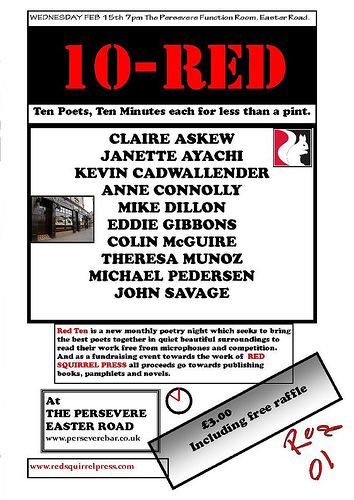
10-RED, Wednesday 15th February, 19.00, The Persevere Function Room, Edinburgh. £3.00 entry.
10 RED is an evening of poetry in the beautiful Victorian Lounge of the Persevere Bar, Easter Road, Edinburgh. All the poets performing are published by Red Squirrel Press, who kindly published my pamphlet, The Mermaid and the Sailors, early last year. I’m hoping to try out some new material on a friendly crowd! Some great folk on the bill, too — worth coming along for McGuire alone! You can see a trailer for the event right here:

.
“Making Poems, Writing Histories, Excavating Myths”: a lecture by Claire Askew for the Melrose Literary Society, Tuesday 21st February, 19.30, The Ormiston Institute, Melrose. £3.00 entry, non-members welcome.
The truly lovely people at the Melrose Literary Society have asked me to come and talk about my current research, and I am incredibly flattered, very excited and utterly terrified all at once. Come and hear me grapple with the question of Why We Write Poems, and investigate the ways in which poetry informs history, history informs myth and the two inform all kinds of creative writing. You’ll also get chance to ask me probing questions!

.
Edinburgh Literary Death Match: March, Tuesday 27th March, 19.00, Voodoo Rooms, Edinburgh. £5.00/£8.00 ticketed — get tickets here!
You’ve probably heard of the massive worldwide phenomenon that is Literary Death Match…? If not, get on it, because it’s a big deal! I’m super flattered to have been nominated (by the fabby @LynseyMay) and invited to perform at Edinburgh’s hippest literary outpost. The Voodoo Rooms is a gorgeous venue and I’m up against some serious talent… Gavin Inglis = legend! Grab your tickets, quick!

.
Three Red Squirrel Poets at Trashed Organ’s “Belonging Fest” Opening Night, Monday 30th April, venue and time TBC, Newcastle
Details of this one are still TBC, but let’s just say it’s going to be good. Watch this space!

.
Got an event you’d like me to read at? Talk about? Attend? Email me via claire @ onenightstanzas.com and tell me about it!

Being a good poet.

Thursday, April 7th, 2011

“I despair the distinction made between “page” and “performance” poets. A good poem is a good poem, it matters not one jot what style it is. If the writer is also able to give a verbal delivery that is enjoyable to an audience then surely that is a good thing. I fail to see how it could be other. Being a good poet does not mean one cannot be an equally good performer. And vice versa! Also NOT being a good performer has absolutely no bearing whatsoever on one’s ability to write good poetry. Anyone who writes good poetry, is able to deliver said poetry well, and WISHES to do so in public, should — to my mind — be encouraged to do so.”

- Fiona Lindsay, Edinburgh-based, barefoot, slam-winning poet.

(Photo)

Subscribe to ONS! Add to Technorati Favorites

this collection FRIENDLY POETRY SLAM: the fallout

Wednesday, April 6th, 2011


Slam virgin Cat Dean wows the slam crowd at the Banshee Labyrinth.

I’ll admit – I was worried about how this event might go down. My aims for the slam were manifold. Firstly, I wanted to drag a few more “page” poets (i.e., poets who are normally more at home publishing in journals and books, and reading at traditional stand up readings) kicking and screaming into the performance scene – mainly to show them that hey, it’s really not that different or scary and look, there’s good poetry to be found here. Secondly, I wanted to get the message across to the performance crowd (although they do tend to be more receptive to stuff outside their own field of literary experience) that page poets can be fun, and that they can – sometimes, at least – perform. Mostly, I wanted to try and narrow the divide that – in spite of the best efforts of fabulous folk like Jenny Lindsay, who has been organising very open and approachable performance events for years – still stubbornly exists between page and stage in the Scottish poetry community.

As I say, this was by no means the first friendly slam that’s ever taken place. Indeed, I’m proud of the fact that Scotland seems to be at the forefront of new and innovative thinking when it comes to slamming and other performance poetry events. Over the past few years there have been one or two “sotto voce” or “quiet” slams about the place – the now-sadly-defunct VoxBox held a “quiet” slam specifically for page poets, and the Scottish Poetry Library also did a sotto slam in 2009, which yours truly here somehow managed to win. Working in this tradition, I wanted to further mess around with the traditional slam format, and by doing so, I hoped to chip away at some of the myths and misconceptions surrounding the phenomenon.

The main difference was in the scoring of the poems. I’m defiantly against the “traditional” slam scoring method, which involves the audience getting involved in rating each poet. In the US, where slams are always well-attended and often patronised by folk who are not either a) poets or b) friends of poets, I can see how this system could work… but in Scotland, where almost everyone in the crowd is a friend/enemy/editor/publisher/workshop buddy/love interest of at least one of the performers, it makes for skewed results. The poet with the most mates wins, to put it simply. The other traditional slam scoring option is the use of a judging panel. But this was a this collection event, and this collection is very much anti-hierarchy, anti-quality-control, anti-curation. To gather a panel of “esteemed judges” for the poets to impress was really not our style.

Instead, we decided to let the poets score each other. Each poet received a personalised score-card, which bore the names of all the poets performing, except for their own – so they could not award points for their own performance. Scores were out of 30 (10 for content, 10 for delivery, and 10 for that individual’s particular “overall opinion”), and recorded at the end of every poet’s performance. At the end of each round, all the scorecards were collected up and the scores anonymously tallied. Poets with high scores progressed through the ranks; poets with lower scores fell by the wayside – but everything was on a democratic, peer-review basis, and thanks to the wide variety of poets performing, we were confident that there would be little-to-no bias.

The scoring system did throw up some issues. Most obviously, it was a logistical nightmare. It wasn’t until I received the first batch of scores at the end of the first round that I realised: I was going to have to add up sixteen sets of scores out of 30 for sixteen poets within fifteen minutes. In round one alone, poets were competing for up to 580 points… that’s a hell of a lot of adding up. Fortunately, I had the help of two glamorous calculator-wielding assistants (my poor, long-suffering flatmates), and we managed, but if I were organising another event of this type, a more simplistic scoring method would have to be devised!

Secondly, several of the poets told me afterwards that they’d found the quick-fire nature of the scoring rather tricky. With only about 30 seconds or so between poets, they had to make snap decisions about the numbers they entered for each. Some said they appreciated this – it prevented them from getting bogged down in thinking and re-thinking their decision, and it meant that their responses were instinctive. Others said they found the whole thing rather stressful, and would have liked a bit more time to reflect on what they’d heard in order to give a score that they felt was reasoned and fair. Next time, I just need to spraff a bit more between performers, I think!

Finally, a couple of people said afterwards that they felt the poets-only scoring left the audience a feeling a little bit surplus-to-requirements. I was really pleased with the enthusiasm the audience were willing to give for each performance in spite of it being quite a long night, but I did note that things cooled off a little in the middle. I’m now thinking that perhaps a compromise of some scoring being done via audience reaction and some done by just the poets may be an interesting avenue to explore.

Otherwise, I was really pleased with the outcome of the scoring experiment, and really interested to see how poets reacted to other performances. Some folk were clearly being very harsh across the board, with some poets scoring certain performances with a big fat zero and never venturing into figures much higher than 6. Others seemed more than happy to dish out perfect 10s across the board to poets they really liked, and – my favourite part of the adding-up process – many of the scorecards came back with doodles, marginalia or explanatory notes decorating their margins. Overall, scoring was extremely close. Numerous folk have noted in their feedback about the evening that poets like Andrew Philip and Dave Coates deserved to move up to the second round, and I agree on both counts. However, it was literally the odd mark here and there that separated 10th place from 11th and 11th from 12th, etc. It was almost too close to call in some cases, and at one point my glamorous assistants and I actually did a re-count to ensure that the right person was getting the correct score. Poets who came lower than they would have liked – or perhaps lower than some of those in attendance felt they deserved – will hopefully be ever-so-slightly placated by the fact that it really was very close indeed.

The main discussion taking place in the aftermath of the slam – and may I take this opportunity to say how happy I am that so much healthy discussion has been generated by the event – concerns the old chestnut of performance vs page. Who had more of an advantage on the night? Who in attendance counts as ‘page’, and who counts as ‘stage’? Did one camp score the other unfairly – was there a bias for or against either side? And so on and so forth. Personally, while I am watching these discussions with interest, and chipping in every so often (of course), I’m kind of sad to hear these questions being raised. As I said above, my aim for the evening was to temporarily erase – or at least blur – the dividing line that exists between page and performance poets; to see the two sides of the poetry world come together and yes, compete… but also to listen to and acknowledge each other. And it felt like this happened on the night itself. In many cases it was difficult to ascertain who belonged to which camp – over at Tonguefire, commenters are scrabbling to define poets like Alec Beattie (whose set was decidedly performance-esque, but read from a book and something of a departure from his usual work), Colin McGuire (a poet who performs with great gusto but who normally shies away from performance-heavy gigs and whose stuff works brilliantly on the page too) and Emily Dodd (a poetry slam virgin… but one who embraces audience participation). I think it’s only later that the feeling of never-the-twain-shall-meet has begun to slink back in, which perhaps is inevitable. For me, the night itself did exactly what I wanted it to: it picked up the traditional make-your-own-slam kit and gave it a bit of a shake, and it got page-folk and stage-folk up to the same mic, and forced them to rate (or, indeed, slate) one another… all of which involved everyone listening carefully to everyone else. The array of talent on show was refreshingly varied and – if you ask me – of excellent quality, and everyone seemed to have a damn good night. It might take a few more of these things before folk really start thinking differently about how poetry is performed and received in Scotland, but for now, I’m really quite pleased.

Responses to the this collection slam:

“A great learning experience for us novices and some wonderful poems and performers.” – Alec Beattie

“It was a great success, with consistent quality and entertainment, from a controlled crowd of temporary human beings and poets…I think there may be more this collection SLAM nights to come. I hope so. Let there be mic!” – McGuire (more here

“I loved that Claire did something new with slams, and particularly that the ‘friendly’ tag encouraged folks to take part who usually wouldn’t touch slam with a barge pole. A couple o the scores raised my eyebrows - but that’s always the case with competitions isn’t it?” – Jenny Lindsay

“stand-out poems of the evening were Colin McGuire’s “Wrap the children in white”, Mairi Campbell-Jack’s “The Book of Antonyms” and Stephen Welsh‘s newspaper poem in the last round. Colin’s poem set me in mind of some of Neruda’s work, with its combination of surreal imagination, incantatory impetus and political edge. Mairi’s poem seemed to me to mark a significant and exciting step forward in her writing, and I was really impressed with how well she read. Stephen had cut up a Sunday Herald report of the weekend’s protests in London and blanked out certain portions, creating a beautiful, strange, quirky, lyrical, powerful poem — perhaps not so much found poetry as released.

Hearing those poems alone would have made it a worthwhile evening, but there were others. I particularly enjoyed “Scotland as an Xbox Game” by Andrew C Ferguson — just the sort of witty, imaginative examination of the hame nation that appeals to me. Dave Coates also read good work but unfortunately joined me in the junkyard after the first round; that’s just the risk you run at these things. And I liked the sci-fi poem that Russell Jones read in the second round.” – Andrew Philip (more here)

“I know what you were trying to do [at the slam] and there is movement in that direction we can see in the quiet slams that have been held. It’s fair enough and I really liked the poet judge thing.” – Tickle McNicoll

“The night was an enjoyable one, though, holding a friendly atmosphere and quick pace that kept things interesting. If you didn’t like a poet you only had to put up with them for 2.5 minutes, much like my love life.” – Russell Jones (more here

You can find photos of the event here.

Anyone else want to offer feedback? If so, link me to your thoughts or drop a line to [email protected]. All comments welcomed!

Subscribe to ONS! Add to Technorati Favorites